Before you argue about matte versus gloss or foil versus emboss, one decision quietly sets the price and the schedule of a custom folding carton: which press it prints on. Offset, flexo, and digital are not interchangeable quality tiers. They are different economics, and the right choice is driven mostly by how many cartons you need and what board they print on. Get the process right and the finish choices fall into place; get it wrong and you either pay for plates you did not need or fight a per-unit price that never comes down. The figures below are indicative industry ranges, not fixed quotes, but the relationships hold across suppliers.
Offset: the quality benchmark for retail cartons
Offset lithography is what most premium retail packaging prints on, and for good reason. It delivers the highest halftone fidelity, the cleanest edges, and the widest color gamut of the three, which matters when a carton has to sit on a shelf next to national brands. It prints on effectively any paperboard you would use for a carton, from lighter coated stock around 200 grams per square meter up to heavy rigid board near 600, and it supports foil stamping, spot UV, and embossing as inline or closely integrated operations. The cost lives in the plates. Each color needs its own plate, indicatively thirty to sixty dollars apiece, so a four-color job with a couple of spot brand colors pays that several times over before a single carton comes off the press. That fixed cost is trivial spread over a long run and punishing over a short one. Lead time typically runs about seven to ten days.
Flexo: the long-run workhorse for rougher board
Flexography uses flexible relief plates and shines where offset is awkward: corrugated, kraft, and rougher, uncoated surfaces, the kind of stock behind a lot of natural-look retail and shipping-forward packaging. Plate costs are similar to offset, roughly thirty to fifty dollars per color, so like offset it rewards volume. The tradeoff is resolution. Flexo carries lower halftone detail and more dot gain than offset, and its color gamut is narrower, so fine gradients and photographic imagery are not its strength. Where it wins is long runs on substrates offset does not love, at a slightly faster turnaround of about five to seven days. If your carton is kraft and the run is large, flexo is often the natural home for it.
Digital: no plates, short runs, and speed
Digital printing skips plates entirely, which changes the math completely at low quantities. With no per-color setup, a short run does not carry a fixed cost that has to be amortized, so digital is the cheapest option from a single unit up into the low thousands. It also turns around fastest, roughly two to four days, and it enables versioning and variable data, so twenty different SKUs or regional variants can run in one job without new plates each time. The limits are real: digital works most consistently on smooth and coated stocks and is less reliable on heavily gloss-coated or rough board, its gamut trails offset in the lightest tones, and finishes like foil have to be added as a separate post-press operation that carries its own setup of roughly two to five hundred dollars.
Where the lines cross
The whole decision comes down to run length, and the crossover is more concrete than most buyers expect.
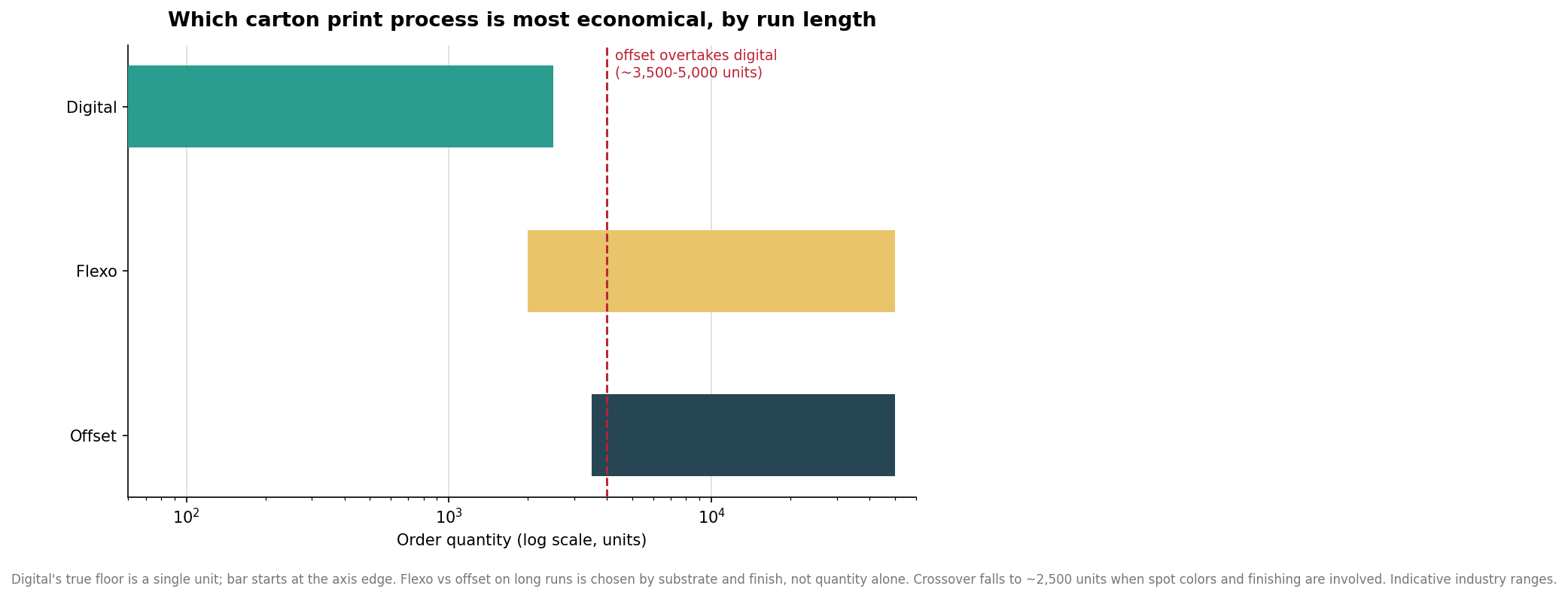
For standard four-color work, digital is cheapest up to somewhere around fifteen hundred cartons, and offset pulls ahead once you pass roughly thirty-five hundred to five thousand. The exact crossover moves with complexity: add multiple Pantone spot colors and finishing, and offset’s advantage arrives earlier, closer to twenty-five hundred units, because those elements load more fixed cost that volume dilutes. The gap at the extremes is stark. Below about fifteen hundred units, offset’s plate burden can push its per-unit price to two or three times what digital would charge, and at ten thousand units the relationship flips, with digital running two to three times the cost of offset. Flexo occupies the long-run lane alongside offset, chosen over it by substrate and finish rather than by count.
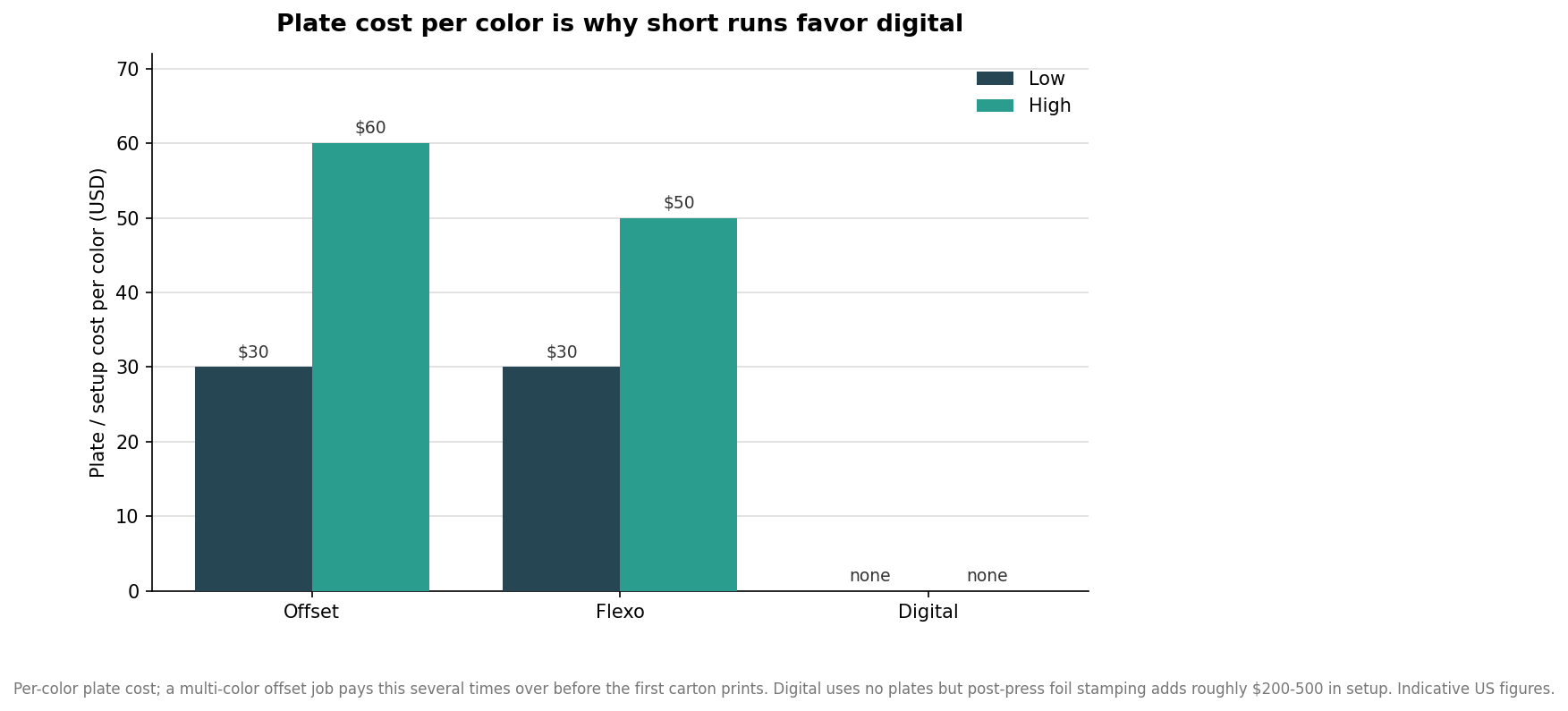
The plate chart is the whole story in miniature. A process with zero setup wins when the run is too short to spread setup over, and a process with cheap per-unit printing wins once the run is long enough to bury its setup. That is why the same carton art can be genuinely cheaper on three different presses depending only on how many you order.
Choosing for your order
Estimate the quantity you will actually use before the artwork changes, not just this first order, because reprints on the same plates are cheap and a process switch between runs is not. Weigh the board: coated stock for a shelf carton is comfortable on any of the three, while kraft or corrugated points toward flexo, and heavily textured or very heavy board points away from digital. Count your colors honestly, since brand-critical spot colors both raise offset’s plate count and stretch digital’s gamut. Line up your finishes, remembering that foil and emboss are near-native on offset and flexo but add a post-press step and cost on digital. Finally, check the calendar: if you need cartons in a few days, digital’s two-to-four-day turnaround may decide the matter regardless of unit price. Treat every number here as a starting point for a real quote; your supplier prices the process, board, colors, and finishing together, and that bundle is where the final figure comes from.
Leave a Reply