Customized Cartons

Category: Uncategorized

  • Folding Carton Paperboard Grades: SBS, CUK, and CRB Compared

    Folding Carton Paperboard Grades: SBS, CUK, and CRB Compared

    Every other decision you make about a folding carton — the print process, the finish, the die-cut style — sits on top of one choice made first: the paperboard grade. Grade is really two things at once, the fiber the board is made from and the coating on its surface, and it sets the color you start with, how the box feels in the hand, whether it is safe against food, and a large share of the cost. Three grades cover the majority of retail cartons, with two useful variants around the edges. Here is how they actually differ and how to match one to your product.

    SBS: the bright white premium grade

    Solid bleached sulfate is made from 100% virgin bleached chemical pulp, which makes it bright white all the way through rather than just on the printed face. That clean cross-section is why it is the default for cosmetics, pharmaceuticals, and luxury goods, where a grey edge on the carton would undercut the product inside. SBS also has excellent food-contact behavior, carrying no odor or taint, so it is the grade of choice when the board touches food directly. It delivers high stiffness for its caliper and takes fine printing and foil cleanly. The trade-off is price: SBS is the most expensive of the common grades, so paying for its whiteness only makes sense when the product actually shows it off.

    CUK: the strength grade

    Coated unbleached kraft, sometimes labeled SUS, is virgin unbleached softwood pulp with a white clay coating on the front and a natural brown kraft back. What sets it apart is mechanical strength — it has among the highest tear and wet strength of any folding-carton board, which is exactly what a chilled beverage six-pack or a heavy detergent box needs. CUK holds up through refrigeration, condensation, and the weight of multipacked units without failing at the folds. Because the back stays brown, it is not the grade for a box that needs a printable or white interior, but for frozen food, beverage carriers, and anything that has to survive a wet, heavy life, it is hard to beat. Its cost sits below SBS but above recycled board.

    CRB and URB: the recycled workhorses

    Coated recycled board is built from 100% recovered fiber in layers — a white coated top, a grey mixed middle, and a grey back — which is why the cut edge reads grey and the board carries visible recycled character. It is the standard for cereal boxes, tissue cartons, dry goods, and high-volume general retail, where cost and recycled content matter more than a flawless white edge. CRB is less stiff than the virgin grades and can crack along a fold if the score is not set correctly, so tooling and scoring matter more here than with SBS. Its uncoated cousin, URB, skips the surface coating for applications that will not be printed with fine graphics. Both are the lowest-cost grades and the obvious pick when recycled content is a stated requirement.

    One caution on direct food contact. Recycled board can carry mineral-oil and other residues from its recovered fiber stream, so for direct contact with dry or fatty foods it is commonly specified with an inner liner or functional barrier rather than used bare. If the carton holds food directly and recycled content is also required, plan for that barrier in the spec rather than assuming the board alone is compliant.
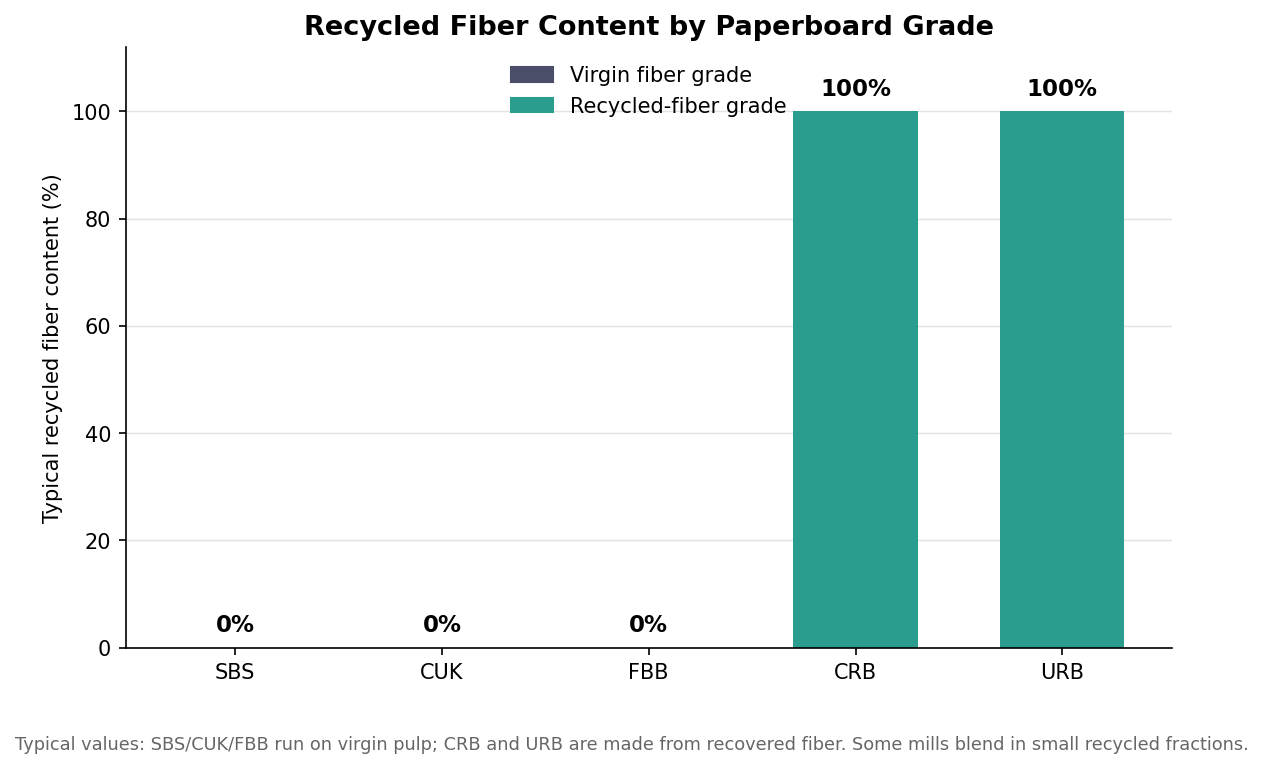
    Bar chart of typical recycled fiber content by paperboard grade showing SBS, CUK, and FBB at zero percent and CRB and URB at one hundred percent
    Recycled fiber content by grade: virgin SBS, CUK, and FBB versus recovered-fiber CRB and URB.

    FBB and micro-flute: the in-betweens

    Folding boxboard is a multilayer virgin board with mechanical pulp in the middle and chemical pulp on the outside, giving it a strong stiffness-to-weight ratio — it feels rigid without being heavy, which is popular in food, beauty, and pharma cartons, especially in European supply chains. Micro-flute is a thin corrugated laminate, a fluted medium sandwiched between two liners, used when a folding carton needs more crush resistance than flat board can give, such as heavier products and premium multipacks that still want a carton look rather than a shipping-box look. Neither is an everyday first choice, but both solve a specific problem the three main grades do not.

    How to choose: caliper, contact, and content

    Start with what the box has to do physically. Caliper — board thickness, measured in points where one point equals one-thousandth of an inch — is chosen to give the carton enough rigidity for its size and the weight it carries, not picked in the abstract. A small pharma carton can run thin because it is small and light, while a beverage multipack needs a heavy caliper in a strong grade because it carries real load. The ranges below are typical planning figures; a taller or heavier box pushes toward the top of its band, and a stiffer grade can sometimes hit the same feel at a slightly lower caliper.
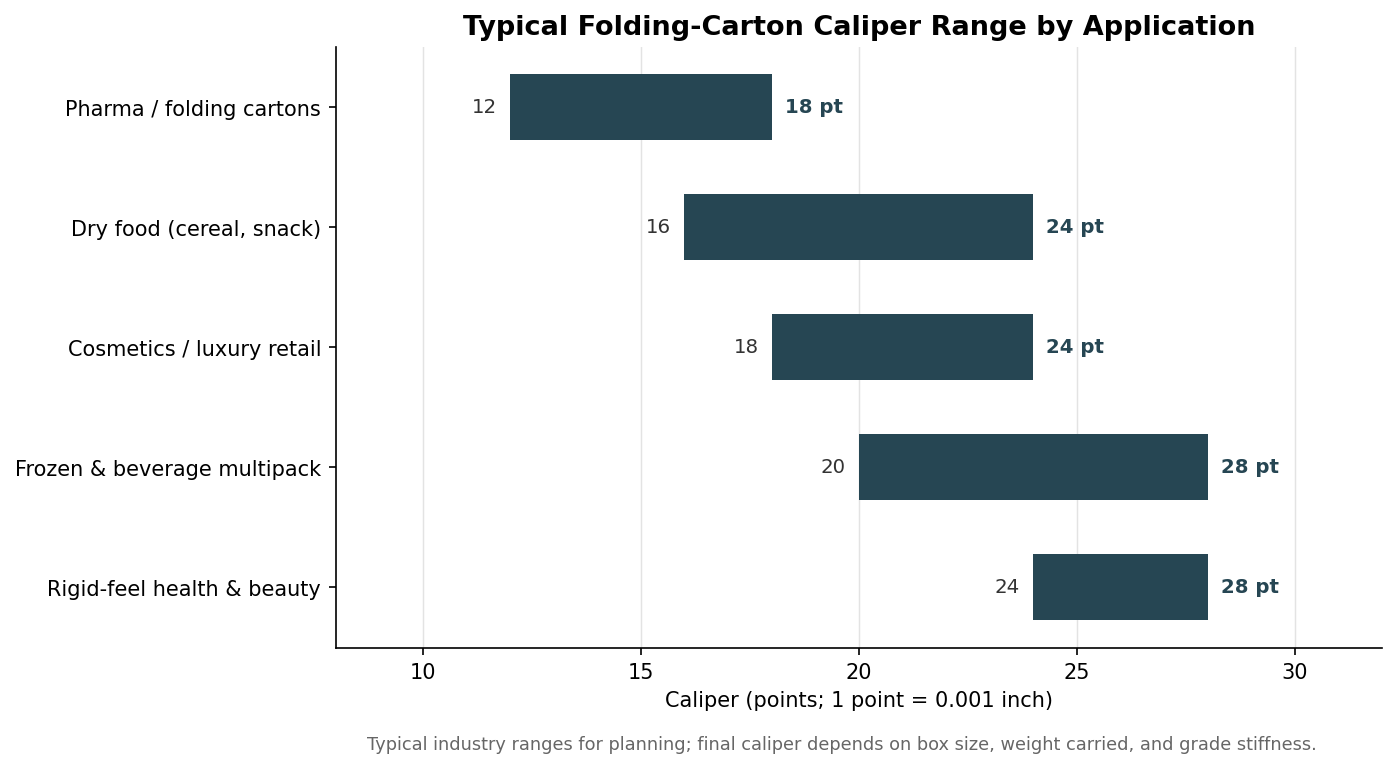
    Range bar chart of typical folding-carton caliper in points by application, from pharma cartons at 12 to 18 points up to health and beauty at 24 to 28 points
    Typical caliper ranges by application; heavier or larger boxes push toward the top of each band.

    Then layer on the two constraints that override feel. If the board touches food directly, that favors SBS or a properly lined grade and rules out bare recycled board. If a buyer or brand requires recycled content, that points to CRB or URB and means designing the scoring and any barrier around the softer, grey board. Everything else — whiteness, foil-readiness, shelf presence — is a preference you balance against cost once those two hard requirements are settled. Nail the grade first, and the print process, finish, and dieline decisions that follow all get easier, because they are being made on a board that already fits the job.
  • Folding Carton or Corrugated Box? How to Choose the Right Custom Packaging

    Folding Carton or Corrugated Box? How to Choose the Right Custom Packaging

    To a buyer clicking through supplier sites, a printed folding carton and a small printed corrugated box can look almost identical. They are made of different materials, though, and picking the wrong one is one of the most common and most expensive packaging mistakes: order folding cartons for something that has to ship on its own and boxes arrive crushed; order corrugated for a light retail product and you pay for bulk and shelf space you did not need. This guide walks through what actually separates the two, where each one wins, and how to decide quickly.

    The one structural difference that drives everything else

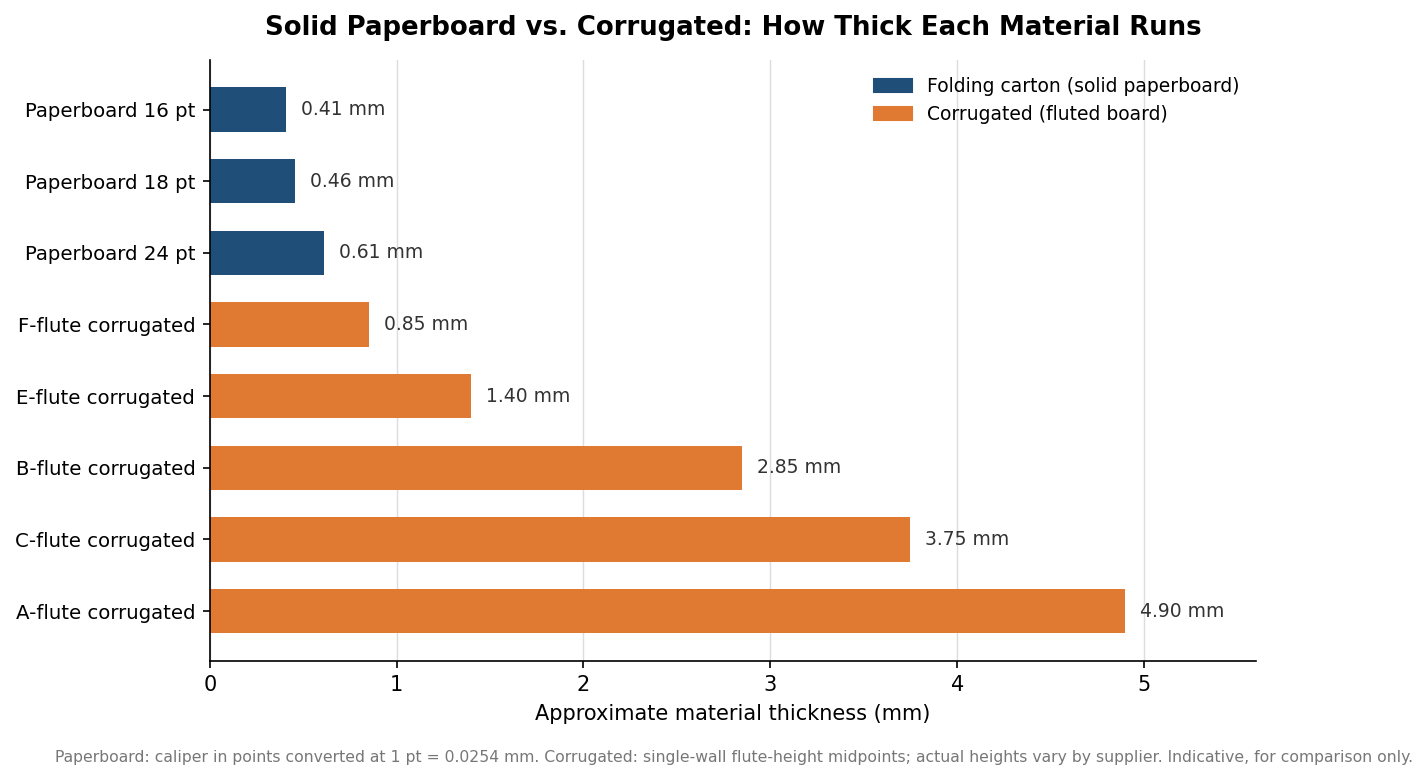
    A folding carton is made from solid paperboard: a single, dense layer with no air in it. Corrugated board is a sandwich, a wavy fluted layer glued between two flat liners, and that trapped air is what gives it stacking strength and cushioning. Everything else, cost, weight, print quality, protection, follows from that one difference. Paperboard folding cartons are typically run in calipers from about 14 pt to 24 pt, which is 0.014 to 0.024 inch, with 16, 18, 20 and 24 pt being the common steps. A 24 pt board is roughly the thickness of a credit card. Single-wall corrugated, by contrast, ranges from under a millimeter for the finest flute up to about five millimeters for the coarsest, several times thicker than even a heavy paperboard.

    Horizontal bar chart comparing folding carton paperboard caliper with corrugated flute thickness in millimeters
    Solid paperboard runs about 0.4 to 0.6 mm; single-wall corrugated ranges from under 1 mm to nearly 5 mm depending on flute.

    That thickness comparison explains the trade in one picture. Folding cartons stay thin, fold flat, and take crisp litho or digital print because the surface is smooth and solid. Corrugated adds height and rigidity but the fluting can telegraph through the print surface unless you use a fine flute or laminate a printed sheet on top.

    Where folding cartons are the right call

    Folding cartons are primary retail packaging. They shine when the box sits on a shelf, holds a relatively light product, and needs to look sharp: cosmetics, supplements, confectionery, small electronics, personal care. Because the board is thin and smooth, it is the better substrate for fine detail, tight registration, foils and spot coatings. As a rough sizing rule, thinner 16 pt board suits very small cartons with a base near 0.75 inch square, 18 pt is a strong everyday choice up to roughly a 2.75 inch base, and you move toward 22 to 24 pt as the panel size and product weight climb past about a 3 inch base. Those figures are indicative starting points, not hard limits; the right caliper always depends on the exact panel dimensions and how the carton will be handled.

    The practical ceiling is weight and abuse. Folding cartons are not built to be the shipping container. If a carton has to survive a parcel network on its own rather than travel inside a master shipper, or if the product runs much past a pound or two, that is the signal you are pushing paperboard past its job.

    Where corrugated earns its place

    Corrugated is a transport material first. Its whole reason to exist is protecting contents through stacking, drops and compression, and the flute profile is how you tune that. Coarser A-flute, around 4.8 to 5 mm tall, and C-flute, around 3.5 to 4 mm, go into shippers, fulfillment boxes and heavier product cartons where cushioning and stacking strength matter most. B-flute, roughly 2.5 to 3.2 mm, is a workhorse for die-cut mailers and canned-goods trays. The finer E-flute (about 1 to 1.8 mm) and F-flute (about 0.7 to 1 mm) are thin enough to hold good print, which is exactly why they show up in retail sleeves, e-commerce mailers and cosmetic outer boxes that also have to take a knock.

    One caveat worth stating plainly: box strength is often described with an edge crush test value such as 200 ECT, but ECT is not a fixed property of a flute type. The same flute can test very differently depending on liner grade and glue quality, so treat any single ECT number as a spec to confirm with your converter rather than a guarantee that comes with the flute name.

    The overlap zone, and why it confuses people

    The reason these two categories blur is the fine-flute middle ground. An E-flute or F-flute corrugated carton can look and print almost like a folding carton while offering real crush resistance, and a litho-laminated box (a printed paperboard sheet mounted on E-flute) gives you folding-carton print quality on a corrugated structure. If your product is retail-facing but also ships direct to consumers, or is fragile enough that solid paperboard feels risky, this hybrid territory is usually where the answer lives. It costs more than a plain folding carton and prints better than standard corrugated, which is the point.

    Matching the board grade to the product

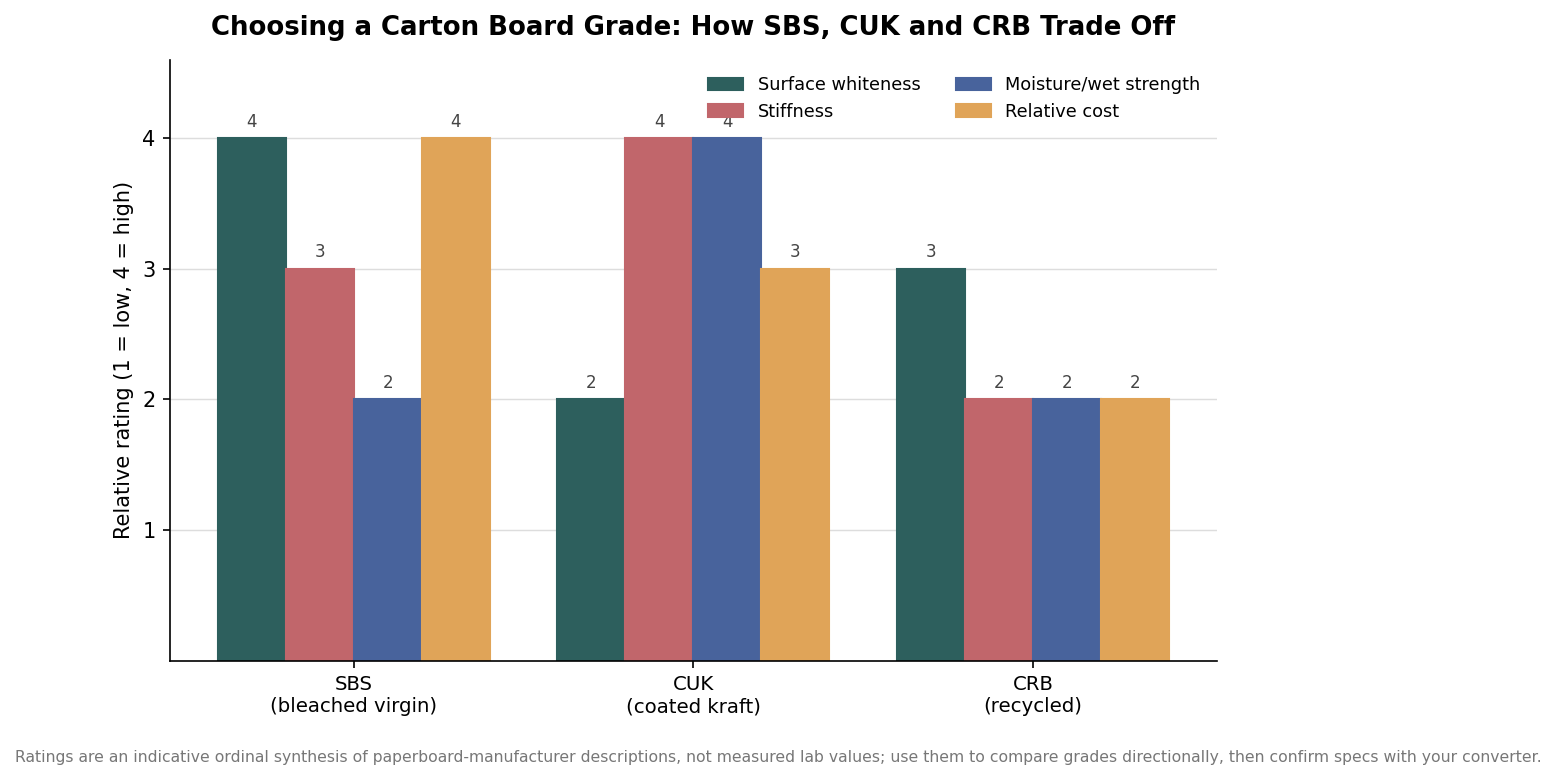
    Once you have chosen paperboard, the grade still matters. Solid bleached sulfate (SBS) is virgin, bright white through the cross-section and the premium choice for cosmetics, pharma and anything needing direct food contact or the cleanest print. Coated unbleached kraft (CUK) trades some surface whiteness for the highest wet strength and tear resistance, which is why it carries beverage multipacks and frozen goods. Coated recycled board (CRB) is the economical, sustainability-friendly option for cereal, tissue and dry goods, at the cost of some stiffness and a slightly greater tendency to crack on tight folds if scoring is not dialed in. The chart below rates those trade-offs directionally so you can shortlist before you ask for samples.

    Grouped bar chart rating SBS, CUK and CRB paperboard grades on whiteness, stiffness, moisture resistance and cost
    How the three common carton board grades trade off on print surface, stiffness, moisture resistance and cost.

    A useful way to close the decision: ask whether the box ships on its own or rides inside a shipper, how heavy the product is, how much the print has to sell the product on a shelf, and where your budget sits. If it is light, shelf-facing and print matters most, a folding carton in the right grade wins. If it has to protect itself in transit or the product is heavy, corrugated is worth the bulk. And if you are honestly in between, a fine-flute or litho-laminated box is the bridge. Whatever you land on, order a physical sample or dieline proof before committing to a production run; a few dollars of prototyping is far cheaper than a truckload of the wrong box.

  • Offset, Flexo, or Digital: Choosing the Print Process for Custom Folding Cartons

    Offset, Flexo, or Digital: Choosing the Print Process for Custom Folding Cartons

    Before you argue about matte versus gloss or foil versus emboss, one decision quietly sets the price and the schedule of a custom folding carton: which press it prints on. Offset, flexo, and digital are not interchangeable quality tiers. They are different economics, and the right choice is driven mostly by how many cartons you need and what board they print on. Get the process right and the finish choices fall into place; get it wrong and you either pay for plates you did not need or fight a per-unit price that never comes down. The figures below are indicative industry ranges, not fixed quotes, but the relationships hold across suppliers.

    Offset: the quality benchmark for retail cartons

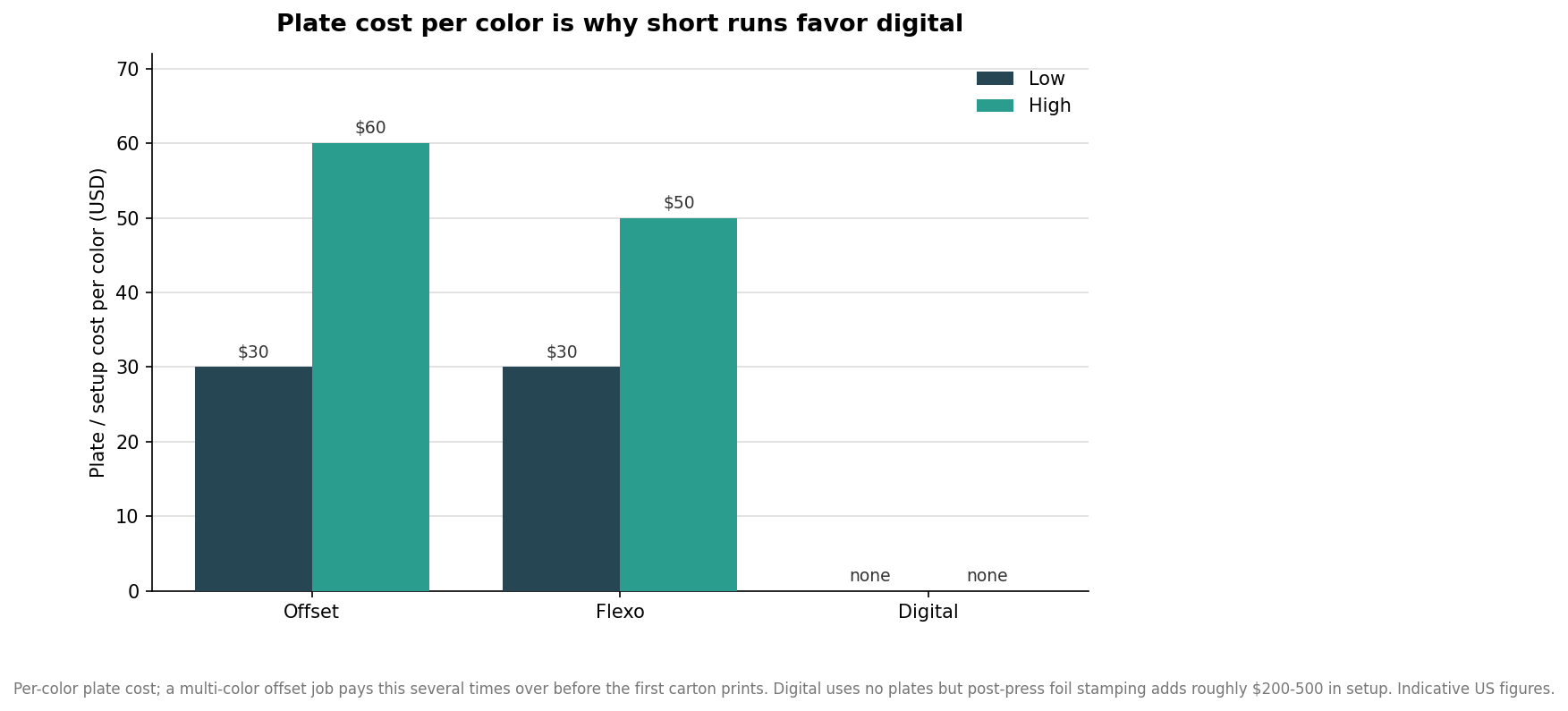
    Offset lithography is what most premium retail packaging prints on, and for good reason. It delivers the highest halftone fidelity, the cleanest edges, and the widest color gamut of the three, which matters when a carton has to sit on a shelf next to national brands. It prints on effectively any paperboard you would use for a carton, from lighter coated stock around 200 grams per square meter up to heavy rigid board near 600, and it supports foil stamping, spot UV, and embossing as inline or closely integrated operations. The cost lives in the plates. Each color needs its own plate, indicatively thirty to sixty dollars apiece, so a four-color job with a couple of spot brand colors pays that several times over before a single carton comes off the press. That fixed cost is trivial spread over a long run and punishing over a short one. Lead time typically runs about seven to ten days.

    Flexo: the long-run workhorse for rougher board

    Flexography uses flexible relief plates and shines where offset is awkward: corrugated, kraft, and rougher, uncoated surfaces, the kind of stock behind a lot of natural-look retail and shipping-forward packaging. Plate costs are similar to offset, roughly thirty to fifty dollars per color, so like offset it rewards volume. The tradeoff is resolution. Flexo carries lower halftone detail and more dot gain than offset, and its color gamut is narrower, so fine gradients and photographic imagery are not its strength. Where it wins is long runs on substrates offset does not love, at a slightly faster turnaround of about five to seven days. If your carton is kraft and the run is large, flexo is often the natural home for it.

    Digital: no plates, short runs, and speed

    Digital printing skips plates entirely, which changes the math completely at low quantities. With no per-color setup, a short run does not carry a fixed cost that has to be amortized, so digital is the cheapest option from a single unit up into the low thousands. It also turns around fastest, roughly two to four days, and it enables versioning and variable data, so twenty different SKUs or regional variants can run in one job without new plates each time. The limits are real: digital works most consistently on smooth and coated stocks and is less reliable on heavily gloss-coated or rough board, its gamut trails offset in the lightest tones, and finishes like foil have to be added as a separate post-press operation that carries its own setup of roughly two to five hundred dollars.

    Where the lines cross

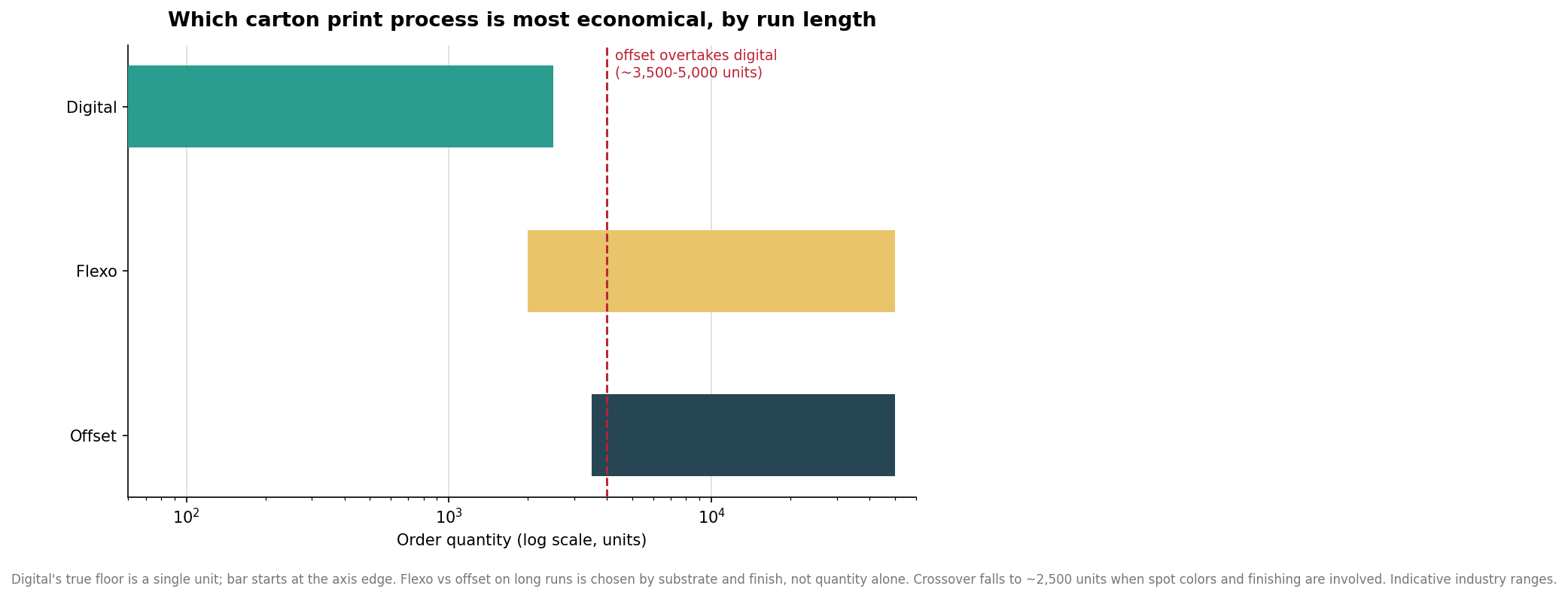
    The whole decision comes down to run length, and the crossover is more concrete than most buyers expect.

    Chart showing the order-quantity ranges where digital, flexo, and offset printing are most economical for folding cartons on a log scale
    Digital wins short runs, offset and flexo win long runs, with the crossover around 3,500 to 5,000 cartons.

    For standard four-color work, digital is cheapest up to somewhere around fifteen hundred cartons, and offset pulls ahead once you pass roughly thirty-five hundred to five thousand. The exact crossover moves with complexity: add multiple Pantone spot colors and finishing, and offset’s advantage arrives earlier, closer to twenty-five hundred units, because those elements load more fixed cost that volume dilutes. The gap at the extremes is stark. Below about fifteen hundred units, offset’s plate burden can push its per-unit price to two or three times what digital would charge, and at ten thousand units the relationship flips, with digital running two to three times the cost of offset. Flexo occupies the long-run lane alongside offset, chosen over it by substrate and finish rather than by count.

    Grouped bar chart of plate or setup cost per color for offset, flexo, and digital carton printing
    Offset and flexo charge per-color plate fees; digital has none, which is why it wins at low volume.

    The plate chart is the whole story in miniature. A process with zero setup wins when the run is too short to spread setup over, and a process with cheap per-unit printing wins once the run is long enough to bury its setup. That is why the same carton art can be genuinely cheaper on three different presses depending only on how many you order.

    Choosing for your order

    Estimate the quantity you will actually use before the artwork changes, not just this first order, because reprints on the same plates are cheap and a process switch between runs is not. Weigh the board: coated stock for a shelf carton is comfortable on any of the three, while kraft or corrugated points toward flexo, and heavily textured or very heavy board points away from digital. Count your colors honestly, since brand-critical spot colors both raise offset’s plate count and stretch digital’s gamut. Line up your finishes, remembering that foil and emboss are near-native on offset and flexo but add a post-press step and cost on digital. Finally, check the calendar: if you need cartons in a few days, digital’s two-to-four-day turnaround may decide the matter regardless of unit price. Treat every number here as a starting point for a real quote; your supplier prices the process, board, colors, and finishing together, and that bundle is where the final figure comes from.

  • How to Spec a Custom Folding Carton: Dielines, Bleed, Caliper, and Tooling

    How to Spec a Custom Folding Carton: Dielines, Bleed, Caliper, and Tooling

    Most custom carton orders that go wrong do not go wrong at the printing press. They go wrong in the file, before anything is printed, because the artwork was never built to the structure of the box. A folding carton is a flat sheet that gets cut, creased, folded, and glued, and the file you hand a printer has to describe all of that, not just carry a pretty label. Getting the specification right the first time is the difference between a clean proof and a week of back-and-forth. Here is how to spec one so it runs.

    The dieline is a map, not artwork

    The single most important file in a carton order is the dieline: a vector template that shows the box unfolded flat, with every cut, crease, and glue area drawn as a separate kind of line. Solid lines mark where the blade cuts the outer edge and any openings. Dashed lines mark creases, the places the board is scored so it folds cleanly. Perforation lines show tear-away features, and glue areas are called out separately so they stay free of coating and heavy ink that would stop the adhesive from bonding. The dieline is an instruction set for building the cutting die, so it is drawn to the exact finished dimensions and is not something you eyeball or scale up from a picture.

    Your printed graphics sit on top of that map, and they have to extend past it. Standard bleed is 0.125 inch, or 3 mm, beyond every cut edge, so that when the blade lands slightly off-register you never get a sliver of bare board at the edge. Bleed matters on internal edges too, the flaps and tuck panels that become visible once the carton is folded, which is exactly where inexperienced files tend to stop the artwork short.

    Keep type out of the danger zones

    The flip side of bleed is the safe area, the interior margin where text, logos, barcodes, and any legally required panels have to live so a small shift in cutting or folding never clips them. The rule that trips people up most is creases: never place text or a barcode across a fold line. When the board bends at a score, ink on that line distorts, cracks, or breaks, and a barcode that crosses a crease can simply stop scanning. Keep the glue flaps clear of ink and coating as well, and confirm that panel sizes account for the small amount of board consumed at each crease, since a carton measured only in its flat state can end up a hair tight once it is folded around a real product.

    Caliper: how thick the board should be

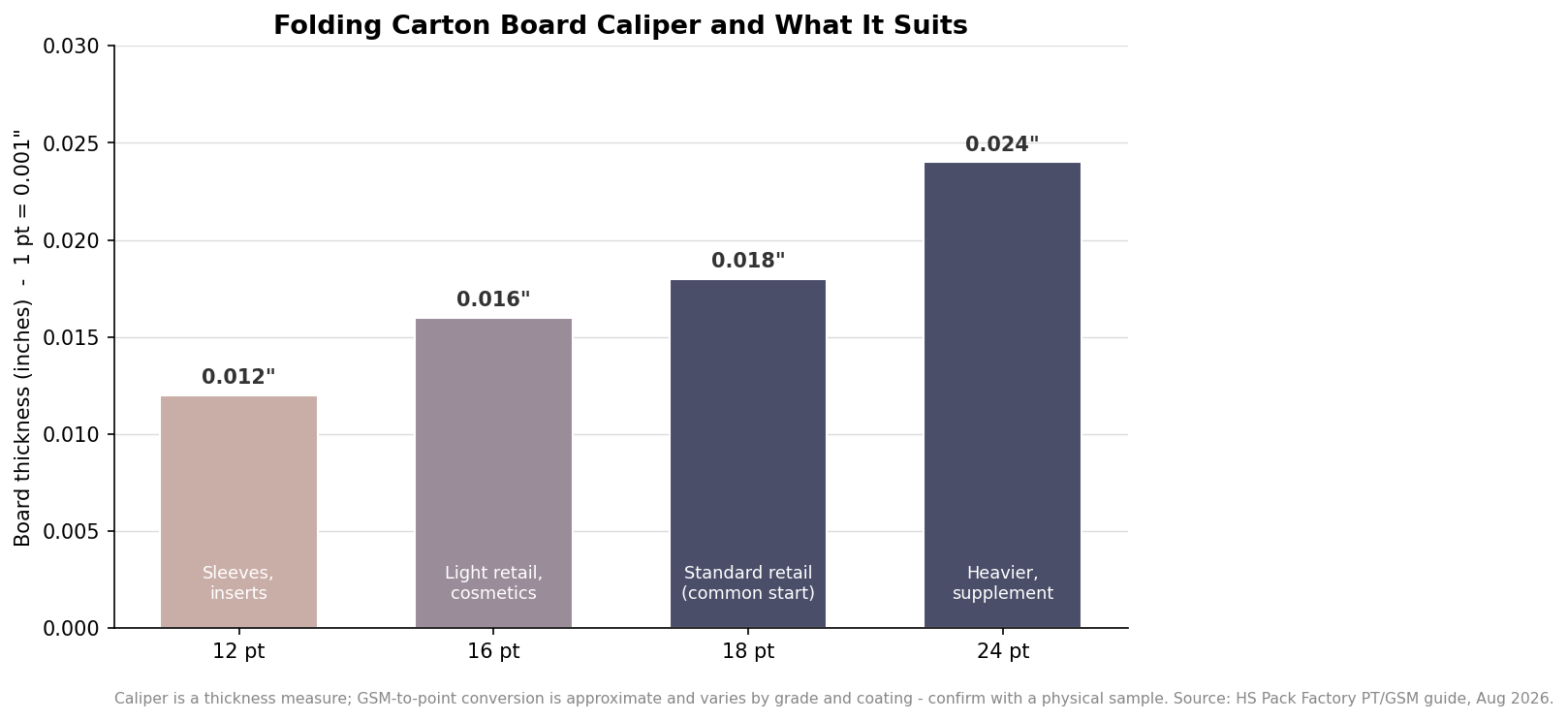
    Board thickness is measured in caliper points, where one point equals one-thousandth of an inch. An 18-point board is 0.018 inch thick. Lighter 10-to-12-point stock suits sleeves and inserts; 14-to-16-point covers small cosmetic boxes and light retail cartons; 18-point is the common starting point for a standard retail folding carton; and 22-to-24-point is chosen for heavier boxes and supplement packaging that need to feel substantial on a shelf. Heavier board resists crushing and reads as more premium, but it costs more, adds shipping weight, and needs its creases dialed in so it folds without cracking.

    Bar chart of folding carton board caliper points 12, 16, 18 and 24 with thickness in inches and typical uses
    Caliper points translate directly to thickness – 18pt is a common starting point for standard retail cartons.

    One caution when a supplier quotes a paper weight in GSM instead of points: the conversion between the two is only approximate, because actual thickness depends on the board grade, fiber density, and coating. Always confirm caliper against a physical sample rather than trusting a GSM-to-point conversion on a spec sheet.

    Why the first carton costs so much

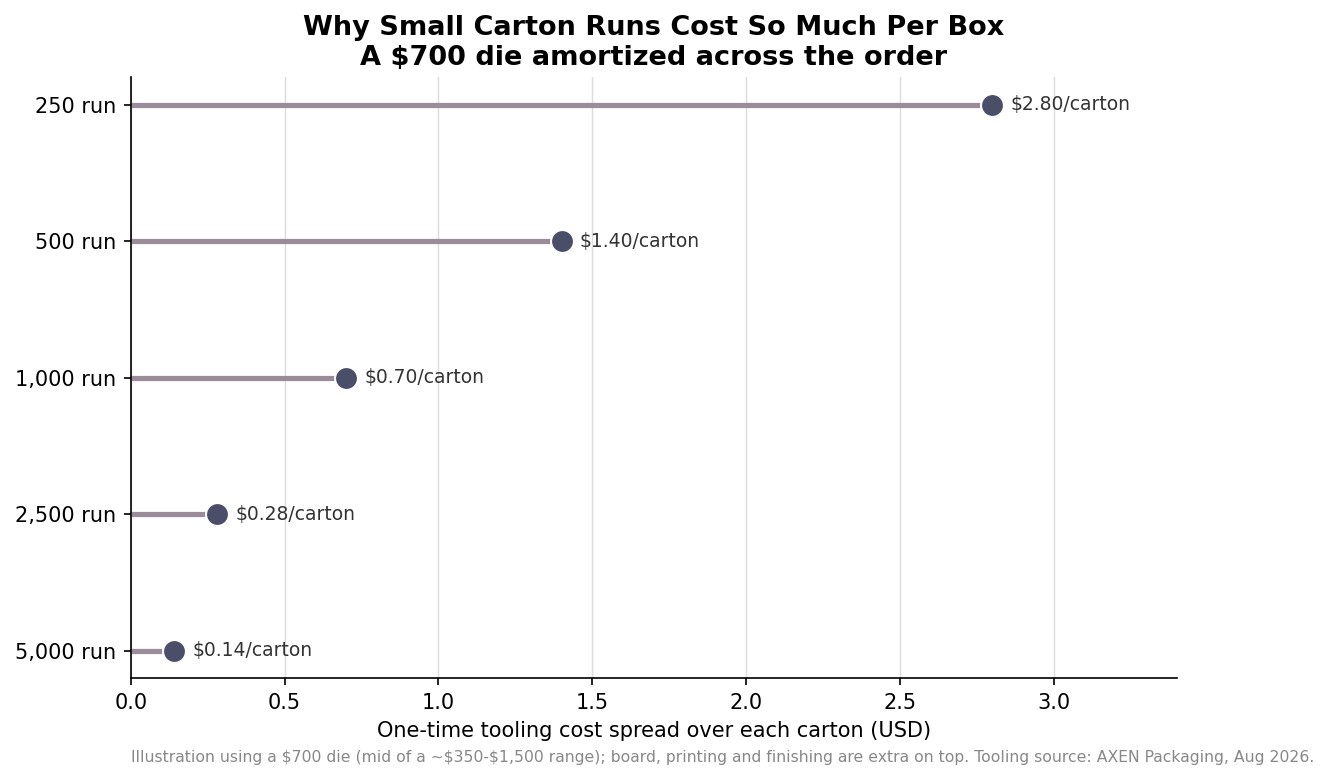
    Custom cartons carry a real one-time cost before a single box ships. The cutting die and tooling typically run somewhere in the range of a few hundred to roughly fifteen hundred dollars depending on the carton’s size and complexity, with features like window cut-outs pushing toward the top of that band. Standard four-color printing plates are usually folded into the job, with extra charges only when a fifth or sixth ink is added. That fixed setup is why small runs feel so expensive per box: the tooling is spread across however many cartons you order, so a die amortized over a few hundred units adds dollars to each one, while the same die over several thousand units adds only pennies.

    Dot plot showing a 700 dollar die amortized across run sizes, from 2.80 per carton at 250 units to 0.14 at 5000 units
    One-time tooling spread over the order is why small carton runs cost so much per box; board and printing sit on top.

    The practical lesson is to order the largest quantity you can realistically use before the artwork or the product changes, because the tooling is already paid for and the marginal cost of more cartons on the same run is low. It is also why reprinting a carton you have run before is far cheaper than the first order: the die exists, so you are paying mostly for board and press time. If you expect to iterate on the design, that is an argument for locking the structure and the dieline first, then treating graphics as the thing you revise.

    What to hand your printer

    To get a clean first proof, give the printer a print-ready file built on their dieline, with artwork on its own layer over the structural template, all fonts outlined or supplied, images at full resolution, and the color built in the process the job will actually print in. Include the 0.125-inch bleed on every edge, keep critical elements inside the safe area, and specify the board caliper, the coating, and any finishing up front so nothing is assumed. When the file describes the box as it will really be cut and folded, the proof comes back matching what you pictured, and the order moves to press instead of back to your inbox.

  • Folding Carton Styles Explained: Matching Box Construction and Board Weight to Your Product

    Folding Carton Styles Explained: Matching Box Construction and Board Weight to Your Product

    When people talk about a custom carton, they usually mean the printing. But the decision that quietly governs cost, assembly speed, and whether the box survives a full shelf is structural: which folding style closes the box, and how thick the board is. Get those two right and the graphics have something worth living on. This guide walks through the common styles, when each one earns its keep, and how to pair it with the correct paperboard.

    Start with fill method and product weight

    Two questions settle most of the choice. First, will the box be filled by hand or on an automated line? Some styles are built to be glued and closed by machinery and are awkward to seal by hand; others assemble in seconds on a packing table. Second, how heavy and how fragile is what goes inside? A lightweight cosmetic tube and a full glass candle put very different demands on the bottom of a carton. Answer those two before you fall in love with a style, because they eliminate half the options immediately.

    It also helps to know that carton style affects material usage. Styles that nest efficiently on the press sheet use less board per unit, which matters at volume. That efficiency is one reason the reverse tuck is so widely produced, and it is a real line item on a quote even when the boxes look nearly identical on the shelf.

    Reverse tuck and straight tuck: the everyday workhorses

    The reverse tuck (often a French reverse tuck) is the default for a reason. Its end flaps close on opposite sides, top tucking into the back and bottom into the front, which lets the blanks nest economically and keeps the price down. It suits light to medium products such as cosmetics, supplements, and pharmaceuticals, and it fills equally well by hand or by machine. The one cosmetic drawback is that the opposing tucks leave a small raw board edge visible when assembled, which some brands dislike on a premium face.

    The straight tuck solves that appearance problem. Here both tucks close toward the same side, so the more finished edge faces front and the box presents cleanly from the primary display angle. The trade is efficiency: straight tuck blanks nest less tightly than reverse tuck, so they use slightly more board and cost marginally more per unit. For a product whose front panel is the hero, that small premium is usually worth paying.

    Auto-bottom and 1-2-3 bottom: when the weight goes up

    Tuck closures are fine until the product gets heavy, and then the bottom becomes the weak point. The tuck-top auto-bottom carton answers this with pre-glued flaps that spring into a locked base as the flat box is opened, so a packer can set up a sturdy carton in one motion. That speed makes it a favorite for hand-filled, lower-volume runs of heavier goods such as candles and bottles. The extra glue joints add manufacturing cost, but they buy real bottom strength.

    The 1-2-3 bottom takes a different route to the same goal. Its base folds together in three sequential steps to form a bottom that is stronger than a plain tuck and, importantly, shows no raw edges. That clean underside and added security make it a common pick for heavier items and for countertop retail displays where the box is handled a lot. Between the two, auto-bottom favors assembly speed while 1-2-3 favors a finished look and maximum strength.

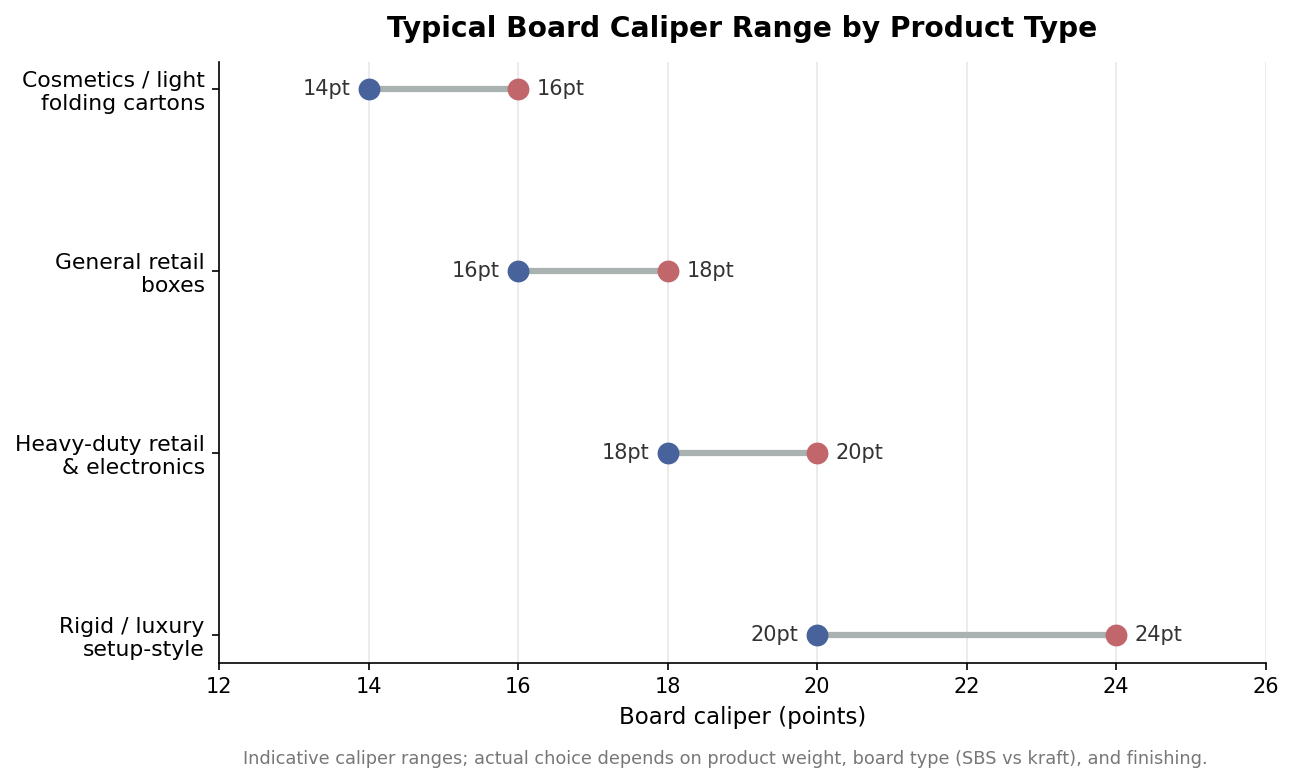
    Range plot of typical paperboard caliper by product type, from 14 to 16 points for light cartons up to 20 to 24 points for rigid luxury packaging
    Indicative caliper ranges rise with product weight and the finish a brand is after.

    Seal end and sleeves: machine lines and overwraps

    The seal end carton is a creature of the packaging line. Four similar flaps fold in and are glued or heat-sealed at top and bottom, producing a sift-resistant closure that keeps powders and granular products contained. It is fast and secure on automated equipment but is not meant for hand filling, since sealing it properly requires glue or tape. If you are running powdered mixes, cereals, or anything that could leak through a tuck, this is the style to specify, provided you have the line to close it.

    The sleeve sits at the opposite end of the spectrum. It is a simple open tube with no top or bottom, cut from a rectangular blank with minimal waste, which makes it the most material-efficient and least expensive option. On its own it offers no product protection, so it works as an overwrap on an existing carton or tray, a way to add branding or a tamper band without paying for a full box. A flat-shipping simplex tray paired with a sleeve or lid is a common way to give a premium product a setup-box feel without the setup-box price.

    Board caliper and type: the second half of the spec

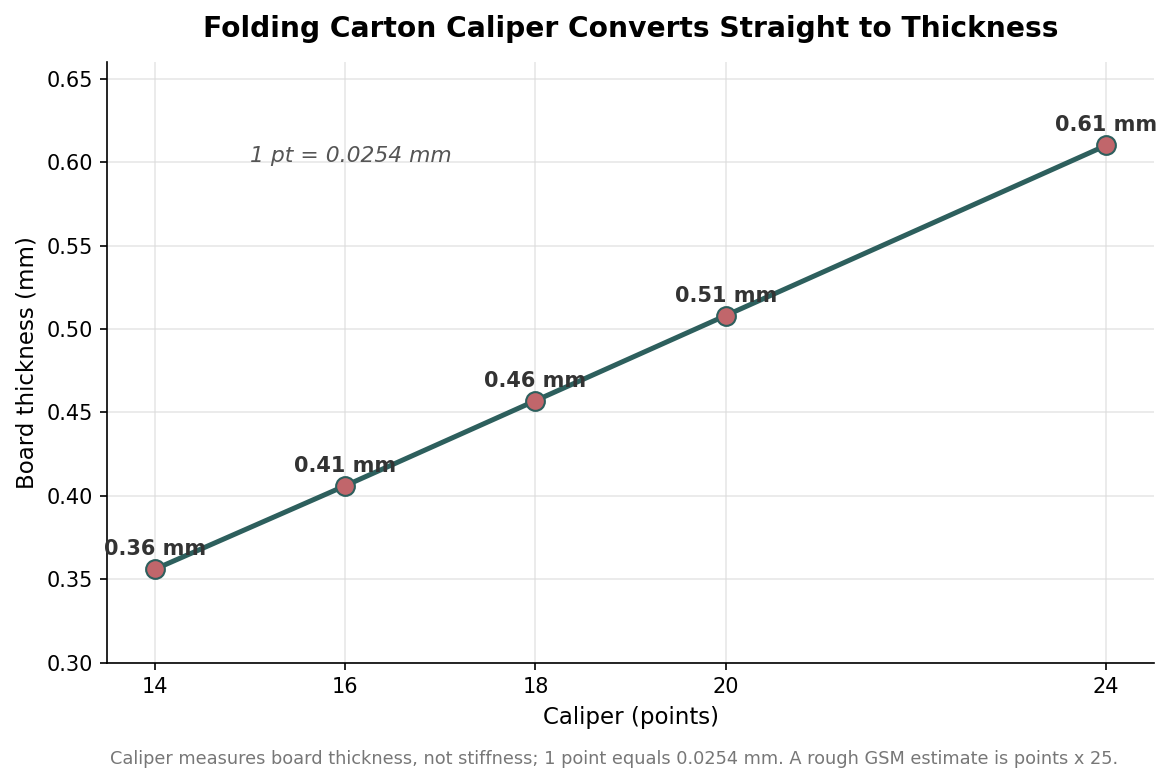
    Style chooses how the box closes; caliper chooses how substantial it feels. Paperboard thickness is measured in points, where one point equals 0.0254 mm, and a rough grammage estimate is points multiplied by about 25. In practice, lighter folding cartons and cosmetics often run around 14 to 16 pt, general retail boxes around 16 to 18 pt, heavier retail and electronics packaging around 18 to 20 pt, and rigid or luxury-leaning cartons at 20 to 24 pt and up. Heavier is not automatically better; an overweight board wastes money and can fight the folds on a delicate box.

    Line chart showing folding carton caliper in points converting directly to board thickness in millimeters, from 14pt at 0.36mm to 24pt at 0.61mm
    Caliper is a direct measure of thickness: one point equals 0.0254 mm.

    Board type matters as much as thickness. Solid bleached sulfate, or SBS, gives a smooth bright-white surface that photographs and prints beautifully, which is why it dominates cosmetics and premium retail. Kraft board keeps its natural brown color and communicates an unbleached, sustainable look while staying strong. Recycled options such as clay-coated news back offer an economical, coated printing surface with a grayer interior, a sensible choice where cost matters more than a pure-white inside. Your printer can also guide the print process itself, from offset for high-fidelity longer runs to digital for short runs and low minimums, and those choices interact with both style and board.

    None of these picks happens in isolation. A candle brand might land on a 1-2-3 bottom in 18 pt SBS with offset printing, while a supplement startup testing a launch might choose a reverse tuck in 16 pt on a digital press to keep the minimum order low. Prices and lead times vary widely with quantity, board, and finishing, so treat any single figure as indicative and confirm the full spec with your printer. Decide the fill method and weight first, choose the style that serves them, then set the caliper and board to match, and the carton will do its job long before anyone notices the artwork.