To a buyer clicking through supplier sites, a printed folding carton and a small printed corrugated box can look almost identical. They are made of different materials, though, and picking the wrong one is one of the most common and most expensive packaging mistakes: order folding cartons for something that has to ship on its own and boxes arrive crushed; order corrugated for a light retail product and you pay for bulk and shelf space you did not need. This guide walks through what actually separates the two, where each one wins, and how to decide quickly.
The one structural difference that drives everything else
A folding carton is made from solid paperboard: a single, dense layer with no air in it. Corrugated board is a sandwich, a wavy fluted layer glued between two flat liners, and that trapped air is what gives it stacking strength and cushioning. Everything else, cost, weight, print quality, protection, follows from that one difference. Paperboard folding cartons are typically run in calipers from about 14 pt to 24 pt, which is 0.014 to 0.024 inch, with 16, 18, 20 and 24 pt being the common steps. A 24 pt board is roughly the thickness of a credit card. Single-wall corrugated, by contrast, ranges from under a millimeter for the finest flute up to about five millimeters for the coarsest, several times thicker than even a heavy paperboard.
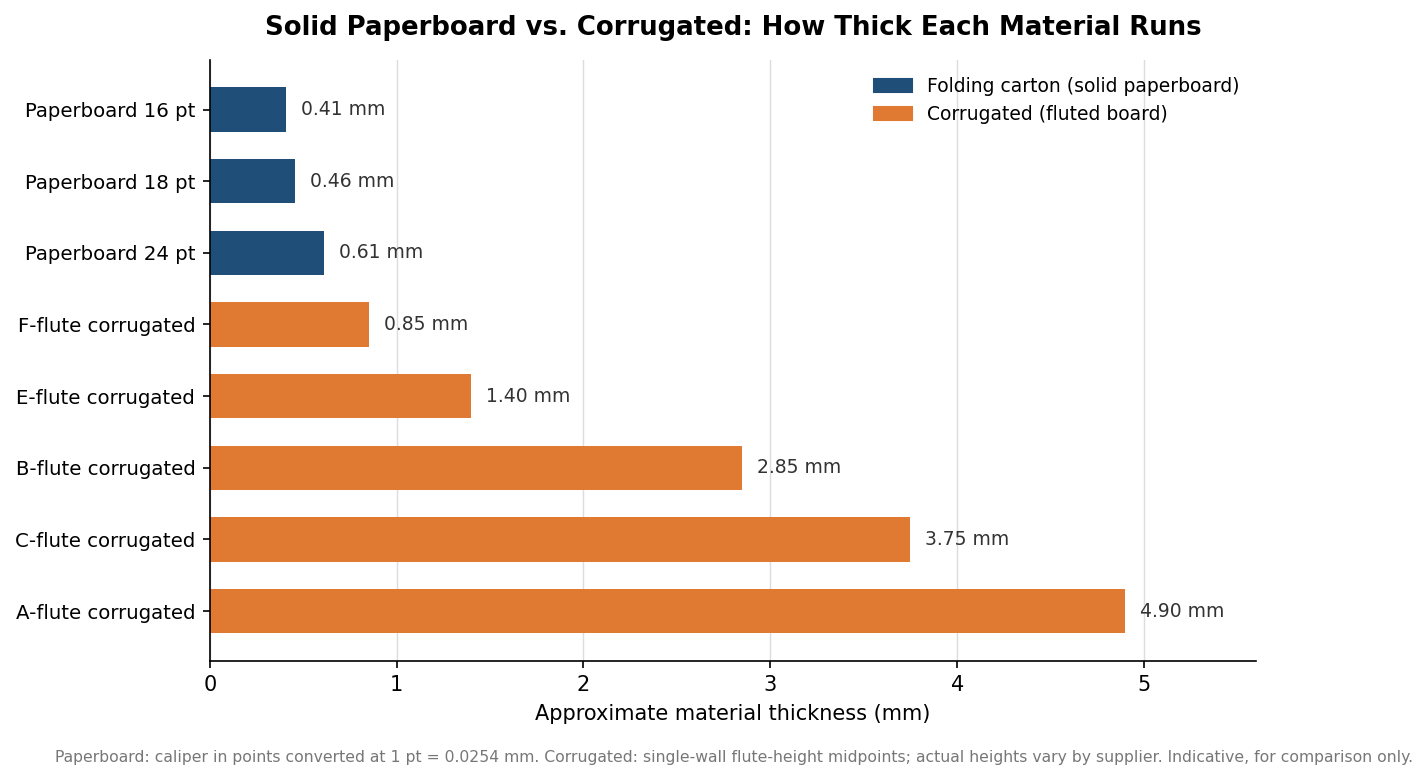
That thickness comparison explains the trade in one picture. Folding cartons stay thin, fold flat, and take crisp litho or digital print because the surface is smooth and solid. Corrugated adds height and rigidity but the fluting can telegraph through the print surface unless you use a fine flute or laminate a printed sheet on top.
Where folding cartons are the right call
Folding cartons are primary retail packaging. They shine when the box sits on a shelf, holds a relatively light product, and needs to look sharp: cosmetics, supplements, confectionery, small electronics, personal care. Because the board is thin and smooth, it is the better substrate for fine detail, tight registration, foils and spot coatings. As a rough sizing rule, thinner 16 pt board suits very small cartons with a base near 0.75 inch square, 18 pt is a strong everyday choice up to roughly a 2.75 inch base, and you move toward 22 to 24 pt as the panel size and product weight climb past about a 3 inch base. Those figures are indicative starting points, not hard limits; the right caliper always depends on the exact panel dimensions and how the carton will be handled.
The practical ceiling is weight and abuse. Folding cartons are not built to be the shipping container. If a carton has to survive a parcel network on its own rather than travel inside a master shipper, or if the product runs much past a pound or two, that is the signal you are pushing paperboard past its job.
Where corrugated earns its place
Corrugated is a transport material first. Its whole reason to exist is protecting contents through stacking, drops and compression, and the flute profile is how you tune that. Coarser A-flute, around 4.8 to 5 mm tall, and C-flute, around 3.5 to 4 mm, go into shippers, fulfillment boxes and heavier product cartons where cushioning and stacking strength matter most. B-flute, roughly 2.5 to 3.2 mm, is a workhorse for die-cut mailers and canned-goods trays. The finer E-flute (about 1 to 1.8 mm) and F-flute (about 0.7 to 1 mm) are thin enough to hold good print, which is exactly why they show up in retail sleeves, e-commerce mailers and cosmetic outer boxes that also have to take a knock.
One caveat worth stating plainly: box strength is often described with an edge crush test value such as 200 ECT, but ECT is not a fixed property of a flute type. The same flute can test very differently depending on liner grade and glue quality, so treat any single ECT number as a spec to confirm with your converter rather than a guarantee that comes with the flute name.
The overlap zone, and why it confuses people
The reason these two categories blur is the fine-flute middle ground. An E-flute or F-flute corrugated carton can look and print almost like a folding carton while offering real crush resistance, and a litho-laminated box (a printed paperboard sheet mounted on E-flute) gives you folding-carton print quality on a corrugated structure. If your product is retail-facing but also ships direct to consumers, or is fragile enough that solid paperboard feels risky, this hybrid territory is usually where the answer lives. It costs more than a plain folding carton and prints better than standard corrugated, which is the point.
Matching the board grade to the product
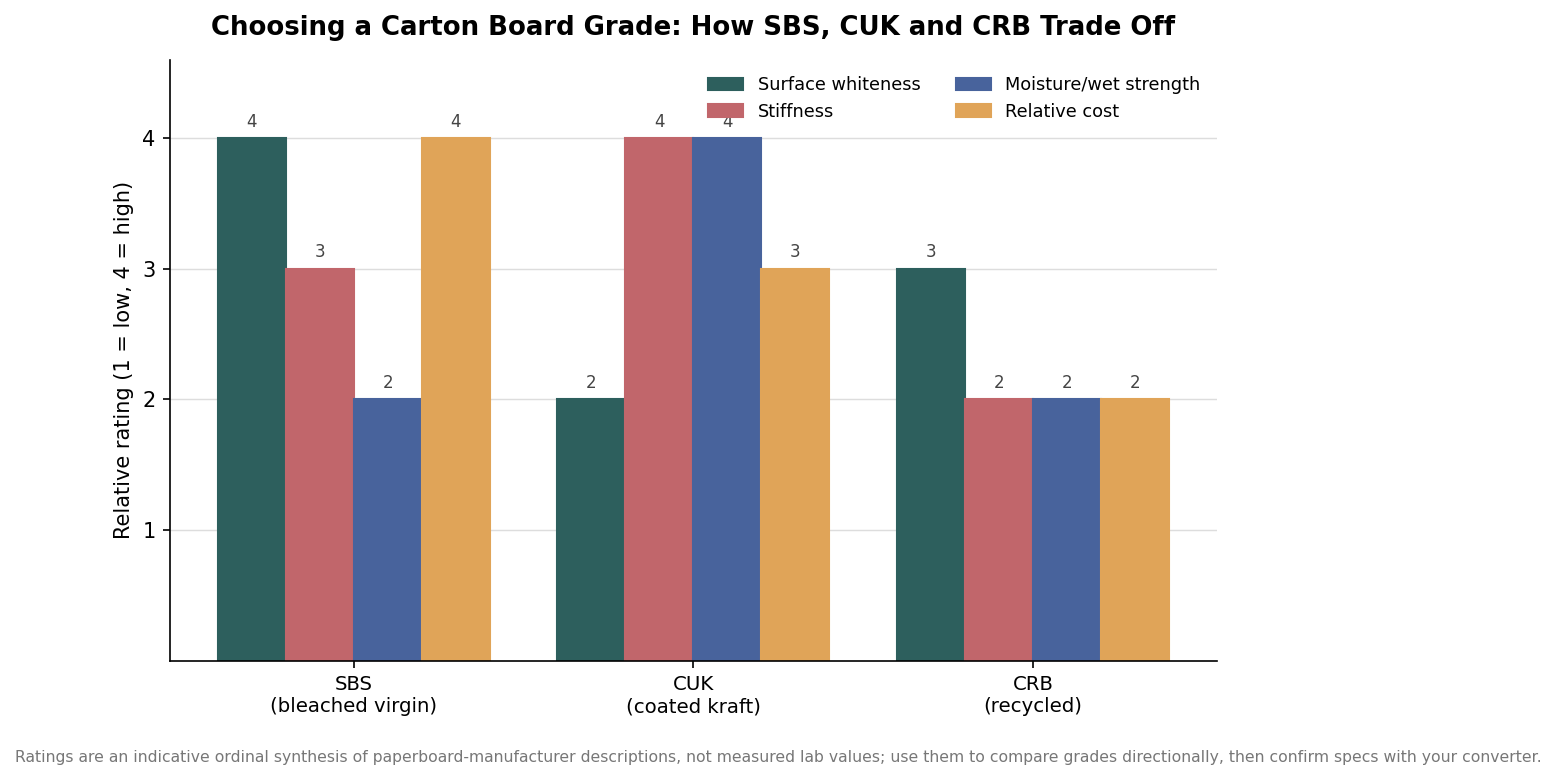
Once you have chosen paperboard, the grade still matters. Solid bleached sulfate (SBS) is virgin, bright white through the cross-section and the premium choice for cosmetics, pharma and anything needing direct food contact or the cleanest print. Coated unbleached kraft (CUK) trades some surface whiteness for the highest wet strength and tear resistance, which is why it carries beverage multipacks and frozen goods. Coated recycled board (CRB) is the economical, sustainability-friendly option for cereal, tissue and dry goods, at the cost of some stiffness and a slightly greater tendency to crack on tight folds if scoring is not dialed in. The chart below rates those trade-offs directionally so you can shortlist before you ask for samples.
A useful way to close the decision: ask whether the box ships on its own or rides inside a shipper, how heavy the product is, how much the print has to sell the product on a shelf, and where your budget sits. If it is light, shelf-facing and print matters most, a folding carton in the right grade wins. If it has to protect itself in transit or the product is heavy, corrugated is worth the bulk. And if you are honestly in between, a fine-flute or litho-laminated box is the bridge. Whatever you land on, order a physical sample or dieline proof before committing to a production run; a few dollars of prototyping is far cheaper than a truckload of the wrong box.
Leave a Reply