Every other decision you make about a folding carton — the print process, the finish, the die-cut style — sits on top of one choice made first: the paperboard grade. Grade is really two things at once, the fiber the board is made from and the coating on its surface, and it sets the color you start with, how the box feels in the hand, whether it is safe against food, and a large share of the cost. Three grades cover the majority of retail cartons, with two useful variants around the edges. Here is how they actually differ and how to match one to your product.
SBS: the bright white premium grade
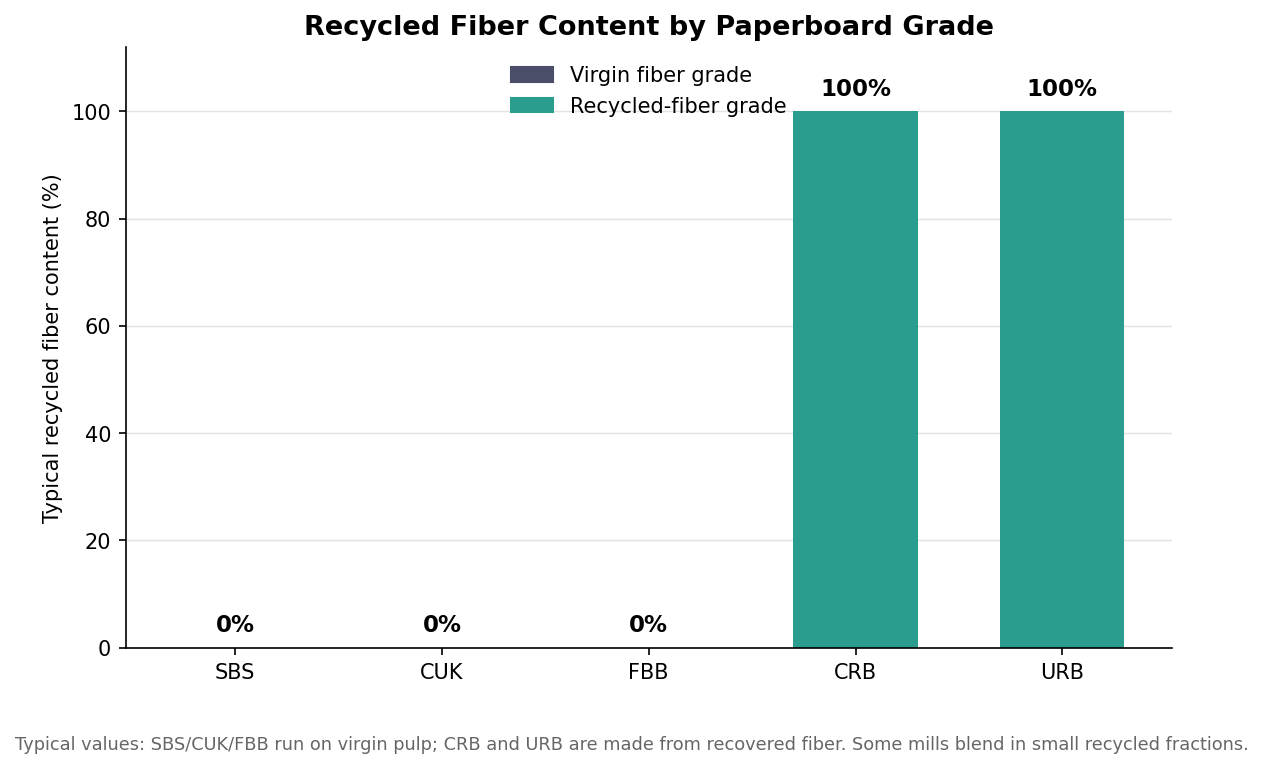
Solid bleached sulfate is made from 100% virgin bleached chemical pulp, which makes it bright white all the way through rather than just on the printed face. That clean cross-section is why it is the default for cosmetics, pharmaceuticals, and luxury goods, where a grey edge on the carton would undercut the product inside. SBS also has excellent food-contact behavior, carrying no odor or taint, so it is the grade of choice when the board touches food directly. It delivers high stiffness for its caliper and takes fine printing and foil cleanly. The trade-off is price: SBS is the most expensive of the common grades, so paying for its whiteness only makes sense when the product actually shows it off.
CUK: the strength grade
Coated unbleached kraft, sometimes labeled SUS, is virgin unbleached softwood pulp with a white clay coating on the front and a natural brown kraft back. What sets it apart is mechanical strength — it has among the highest tear and wet strength of any folding-carton board, which is exactly what a chilled beverage six-pack or a heavy detergent box needs. CUK holds up through refrigeration, condensation, and the weight of multipacked units without failing at the folds. Because the back stays brown, it is not the grade for a box that needs a printable or white interior, but for frozen food, beverage carriers, and anything that has to survive a wet, heavy life, it is hard to beat. Its cost sits below SBS but above recycled board.
CRB and URB: the recycled workhorses
Coated recycled board is built from 100% recovered fiber in layers — a white coated top, a grey mixed middle, and a grey back — which is why the cut edge reads grey and the board carries visible recycled character. It is the standard for cereal boxes, tissue cartons, dry goods, and high-volume general retail, where cost and recycled content matter more than a flawless white edge. CRB is less stiff than the virgin grades and can crack along a fold if the score is not set correctly, so tooling and scoring matter more here than with SBS. Its uncoated cousin, URB, skips the surface coating for applications that will not be printed with fine graphics. Both are the lowest-cost grades and the obvious pick when recycled content is a stated requirement.
One caution on direct food contact. Recycled board can carry mineral-oil and other residues from its recovered fiber stream, so for direct contact with dry or fatty foods it is commonly specified with an inner liner or functional barrier rather than used bare. If the carton holds food directly and recycled content is also required, plan for that barrier in the spec rather than assuming the board alone is compliant.
FBB and micro-flute: the in-betweens
Folding boxboard is a multilayer virgin board with mechanical pulp in the middle and chemical pulp on the outside, giving it a strong stiffness-to-weight ratio — it feels rigid without being heavy, which is popular in food, beauty, and pharma cartons, especially in European supply chains. Micro-flute is a thin corrugated laminate, a fluted medium sandwiched between two liners, used when a folding carton needs more crush resistance than flat board can give, such as heavier products and premium multipacks that still want a carton look rather than a shipping-box look. Neither is an everyday first choice, but both solve a specific problem the three main grades do not.
How to choose: caliper, contact, and content
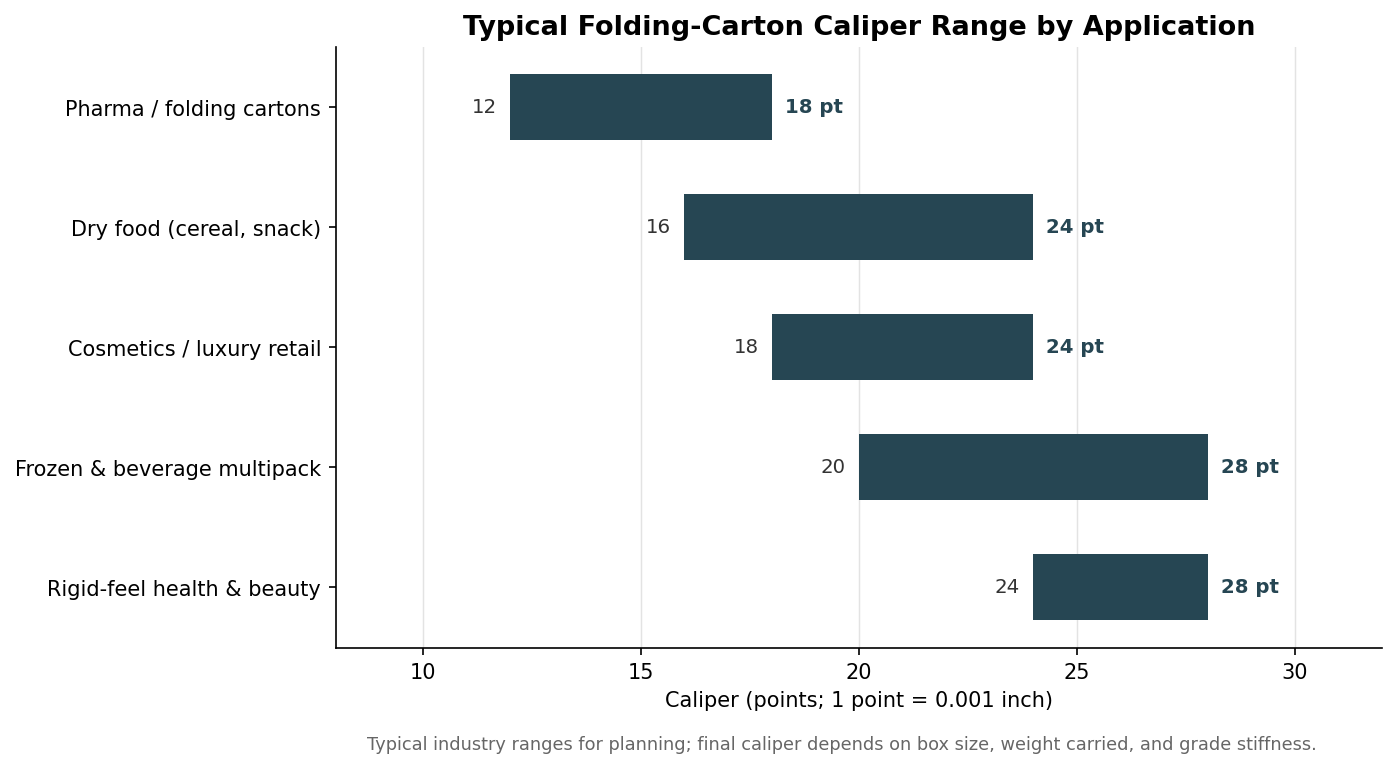
Start with what the box has to do physically. Caliper — board thickness, measured in points where one point equals one-thousandth of an inch — is chosen to give the carton enough rigidity for its size and the weight it carries, not picked in the abstract. A small pharma carton can run thin because it is small and light, while a beverage multipack needs a heavy caliper in a strong grade because it carries real load. The ranges below are typical planning figures; a taller or heavier box pushes toward the top of its band, and a stiffer grade can sometimes hit the same feel at a slightly lower caliper.
Then layer on the two constraints that override feel. If the board touches food directly, that favors SBS or a properly lined grade and rules out bare recycled board. If a buyer or brand requires recycled content, that points to CRB or URB and means designing the scoring and any barrier around the softer, grey board. Everything else — whiteness, foil-readiness, shelf presence — is a preference you balance against cost once those two hard requirements are settled. Nail the grade first, and the print process, finish, and dieline decisions that follow all get easier, because they are being made on a board that already fits the job.
Leave a Reply