When people talk about a custom carton, they usually mean the printing. But the decision that quietly governs cost, assembly speed, and whether the box survives a full shelf is structural: which folding style closes the box, and how thick the board is. Get those two right and the graphics have something worth living on. This guide walks through the common styles, when each one earns its keep, and how to pair it with the correct paperboard.
Start with fill method and product weight
Two questions settle most of the choice. First, will the box be filled by hand or on an automated line? Some styles are built to be glued and closed by machinery and are awkward to seal by hand; others assemble in seconds on a packing table. Second, how heavy and how fragile is what goes inside? A lightweight cosmetic tube and a full glass candle put very different demands on the bottom of a carton. Answer those two before you fall in love with a style, because they eliminate half the options immediately.
It also helps to know that carton style affects material usage. Styles that nest efficiently on the press sheet use less board per unit, which matters at volume. That efficiency is one reason the reverse tuck is so widely produced, and it is a real line item on a quote even when the boxes look nearly identical on the shelf.
Reverse tuck and straight tuck: the everyday workhorses
The reverse tuck (often a French reverse tuck) is the default for a reason. Its end flaps close on opposite sides, top tucking into the back and bottom into the front, which lets the blanks nest economically and keeps the price down. It suits light to medium products such as cosmetics, supplements, and pharmaceuticals, and it fills equally well by hand or by machine. The one cosmetic drawback is that the opposing tucks leave a small raw board edge visible when assembled, which some brands dislike on a premium face.
The straight tuck solves that appearance problem. Here both tucks close toward the same side, so the more finished edge faces front and the box presents cleanly from the primary display angle. The trade is efficiency: straight tuck blanks nest less tightly than reverse tuck, so they use slightly more board and cost marginally more per unit. For a product whose front panel is the hero, that small premium is usually worth paying.
Auto-bottom and 1-2-3 bottom: when the weight goes up
Tuck closures are fine until the product gets heavy, and then the bottom becomes the weak point. The tuck-top auto-bottom carton answers this with pre-glued flaps that spring into a locked base as the flat box is opened, so a packer can set up a sturdy carton in one motion. That speed makes it a favorite for hand-filled, lower-volume runs of heavier goods such as candles and bottles. The extra glue joints add manufacturing cost, but they buy real bottom strength.
The 1-2-3 bottom takes a different route to the same goal. Its base folds together in three sequential steps to form a bottom that is stronger than a plain tuck and, importantly, shows no raw edges. That clean underside and added security make it a common pick for heavier items and for countertop retail displays where the box is handled a lot. Between the two, auto-bottom favors assembly speed while 1-2-3 favors a finished look and maximum strength.
Seal end and sleeves: machine lines and overwraps
The seal end carton is a creature of the packaging line. Four similar flaps fold in and are glued or heat-sealed at top and bottom, producing a sift-resistant closure that keeps powders and granular products contained. It is fast and secure on automated equipment but is not meant for hand filling, since sealing it properly requires glue or tape. If you are running powdered mixes, cereals, or anything that could leak through a tuck, this is the style to specify, provided you have the line to close it.
The sleeve sits at the opposite end of the spectrum. It is a simple open tube with no top or bottom, cut from a rectangular blank with minimal waste, which makes it the most material-efficient and least expensive option. On its own it offers no product protection, so it works as an overwrap on an existing carton or tray, a way to add branding or a tamper band without paying for a full box. A flat-shipping simplex tray paired with a sleeve or lid is a common way to give a premium product a setup-box feel without the setup-box price.
Board caliper and type: the second half of the spec
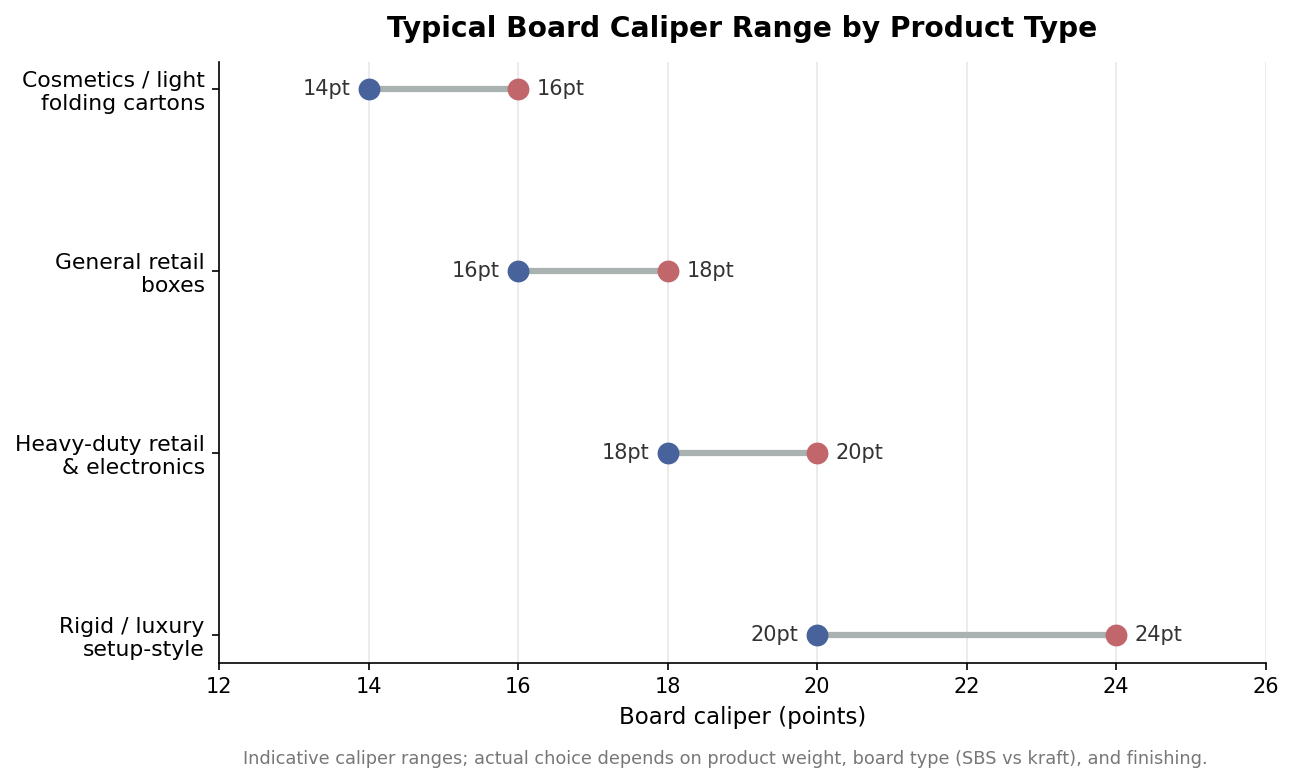
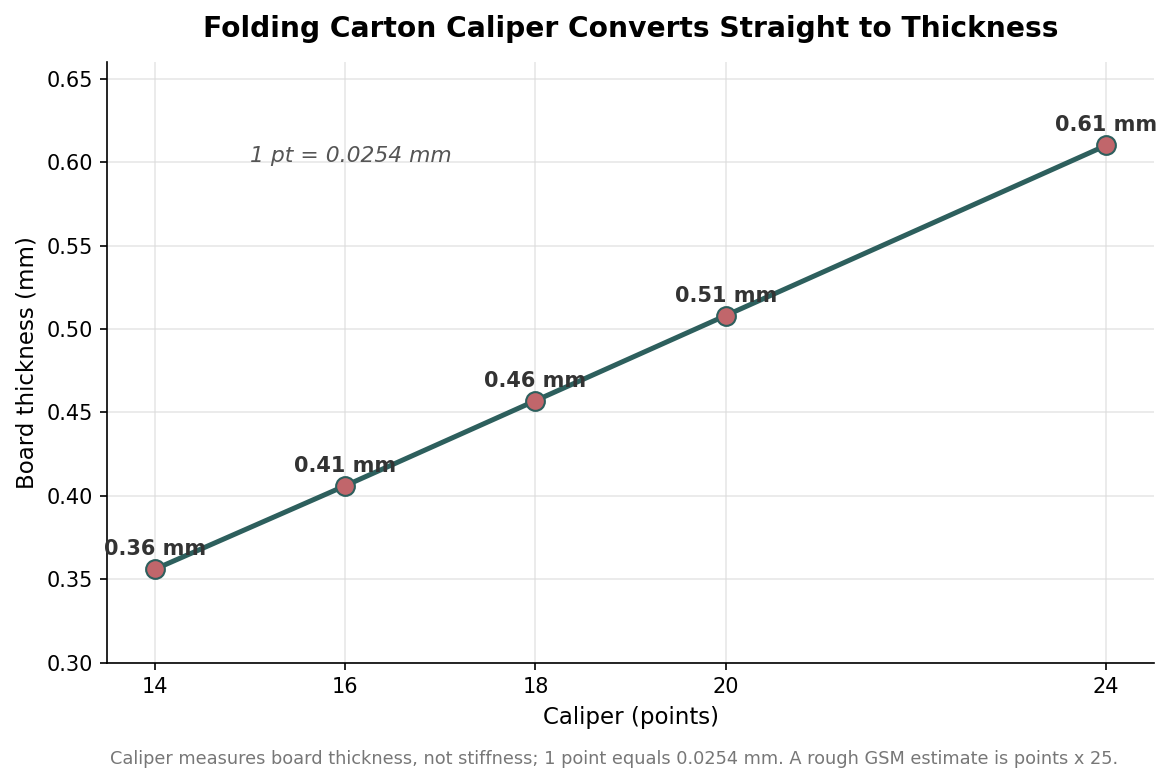
Style chooses how the box closes; caliper chooses how substantial it feels. Paperboard thickness is measured in points, where one point equals 0.0254 mm, and a rough grammage estimate is points multiplied by about 25. In practice, lighter folding cartons and cosmetics often run around 14 to 16 pt, general retail boxes around 16 to 18 pt, heavier retail and electronics packaging around 18 to 20 pt, and rigid or luxury-leaning cartons at 20 to 24 pt and up. Heavier is not automatically better; an overweight board wastes money and can fight the folds on a delicate box.
Board type matters as much as thickness. Solid bleached sulfate, or SBS, gives a smooth bright-white surface that photographs and prints beautifully, which is why it dominates cosmetics and premium retail. Kraft board keeps its natural brown color and communicates an unbleached, sustainable look while staying strong. Recycled options such as clay-coated news back offer an economical, coated printing surface with a grayer interior, a sensible choice where cost matters more than a pure-white inside. Your printer can also guide the print process itself, from offset for high-fidelity longer runs to digital for short runs and low minimums, and those choices interact with both style and board.
None of these picks happens in isolation. A candle brand might land on a 1-2-3 bottom in 18 pt SBS with offset printing, while a supplement startup testing a launch might choose a reverse tuck in 16 pt on a digital press to keep the minimum order low. Prices and lead times vary widely with quantity, board, and finishing, so treat any single figure as indicative and confirm the full spec with your printer. Decide the fill method and weight first, choose the style that serves them, then set the caliper and board to match, and the carton will do its job long before anyone notices the artwork.
Leave a Reply